
SHERG Magazine
LEADING QUALITY: PREPARING FOR ISO 9001:2026
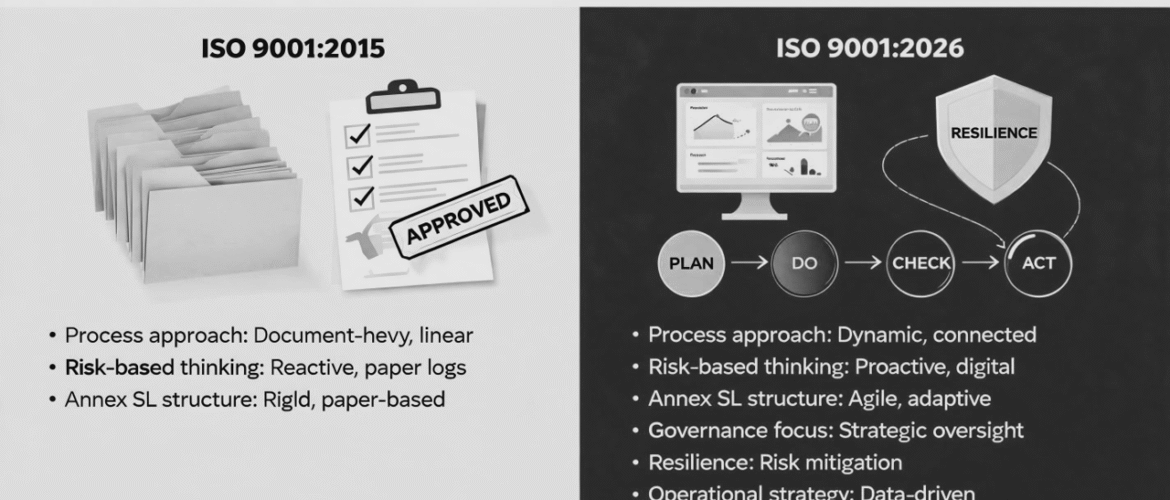
Although the final publication details of ISO 9001:2026 remain subject to the completion of the ISO revision and approval process, the proposed changes emerging from the international drafting stages indicate that the revision is intended to modernize and strengthen the standard rather than fundamentally rewrite it. The core principles of the process approach, risk-based thinking, and the Annex SL harmonized management system structure will remain unchanged, ensuring continuity for organizations already certified to ISO 9001:2015.
The primary purpose of revising the standard after more than a decade is to ensure that ISO 9001 remains relevant and effective within today’s rapidly evolving global business environment. The International Organization for Standardization (ISO) has designed the revision to move Quality Management Systems (QMSs) beyond being viewed as merely compliance or documentation exercises. Instead, the updated standard is expected to position the QMS as a strategic management framework that supports corporate governance, organizational resilience, sustainability, digital transformation, innovation, and long-term business performance.
The revised requirements are intended to better equip organizations to respond to emerging risks, changing stakeholder expectations, technological advancements, supply chain complexities, and environmental and social responsibilities while maintaining a strong focus on customer satisfaction and continual improvement.
Purpose of the Revision
The ISO 9001:2015 standard is over a decade old, and the business environment has changed significantly since then.
The update is driven by the need to address new challenges and expectations, including:
• Digital Transformation and Emerging Technologies: The revision aims to integrate quality management with the opportunities and risks of digitalization, automation, and data-driven decision-making.
• Sustainability and Climate Change: It incorporates considerations for climate change and sustainability as part of an organization’s strategic planning and risk management.
• Ethics and Organizational Culture: There is a growing expectation for organizations to foster ethical behavior and a strong quality culture, which the new standard will explicitly address.
• Stakeholder Expectations: The revision acknowledges the increasing importance of a broader range of stakeholders beyond just customers.
Key Changes Expected in ISO 9001:2026
The main changes are expected to include:
- Emphasis on Quality Culture and Ethical Behavior: A new and significant change is the requirement for top management to actively promote and demonstrate a “quality culture” and “ethical behavior”. This will be a new requirement in Clause 5.1 (Leadership and Commitment), with the goal of embedding quality and integrity into the very fabric of the organization, moving beyond simple compliance to a more holistic governance framework.
- Clearer Separation of Risks and Opportunities: Clause 6.1 will be restructured to clearly separate the determination and treatment of risks from opportunities. It appears the 2015 version led organizations to focus too heavily on risk mitigation, and the new structure aims to promote a more strategic and balanced approach that encourages proactive improvement. This includes separate subclauses for risks and opportunities.
- Strengthened Management of Change: The standard will introduce more robust requirements for managing changes to the quality management system itself (Clauses 6.3 and 8.5.6). This change is designed to ensure that any modifications to the QMS are carefully planned and controlled to support the achievement of intended results.
- Integration of Climate Change Considerations: The 2024 amendment that required organizations to consider climate change in the context of their operations (Clauses 4.1 and 4.2) will now be fully integrated into the standard’s text. This reinforces the expectation that organizations will assess how climate-related issues can impact their ability to provide compliant products and services.
- Clarified and Consolidated Requirements: Several other changes are primarily editorial or for clarification. This includes a new consolidated Clause 10.1 for “Continual Improvement” and a significantly expanded Annex A, which now provides much more detailed guidance on implementing the standard’s requirements. Additionally, the standard will align with a new Harmonized Structure (HS) for consistency with other ISO management system standards.
- Next Steps and Timeline
The transition from ISO 9001:2015 to ISO 9001:2026 is expected to be smoother than the last major revision. However, organizations should start preparing. The final version is expected to be published in September or October 2026, with a typical transition period of 2 or 3 years from the publication date for certified organizations. It is recommended to obtain the draft and become familiar with the changes in advance.
I hope this overview of the expected changes is helpful.